

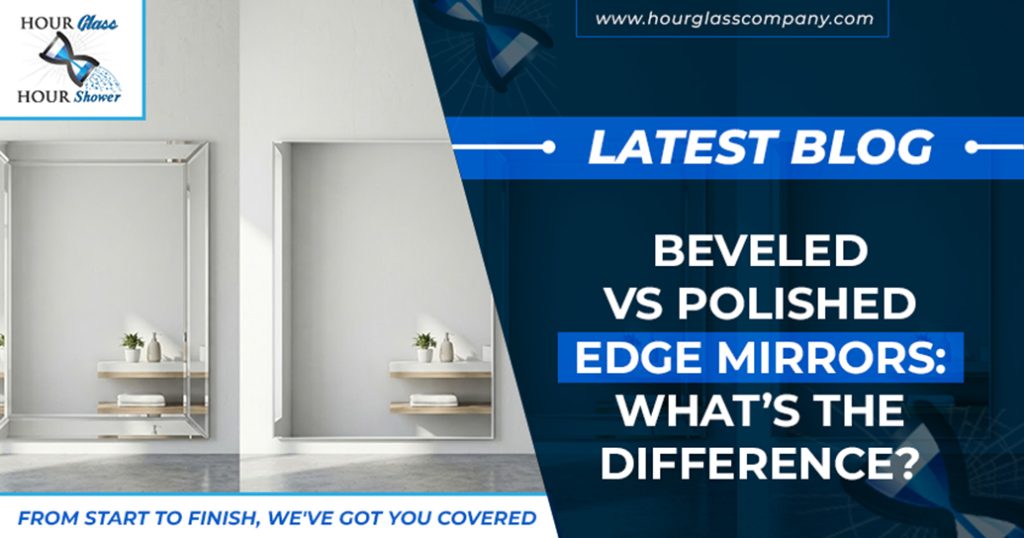
The short answer: a beveled mirror has a sloped, polished strip around its perimeter, while a polished-edge mirror has a smooth finished edge that remains essentially square to the mirror face. A bevel creates a decorative border and catches light; a polished edge creates a cleaner, more understated appearance. For healthcare settings, however, the edge profile is only one part of the decision. Safety glazing, secure mounting, cleanability, moisture exposure, accessibility, and local requirements can matter just as much.
This distinction is especially useful when specifying mirrors for hospitals, outpatient clinics, dental offices, medical practices, assisted-living facilities, and healthcare restrooms. The right mirror should support the space’s visual design without creating avoidable maintenance or safety problems.
Feature | Beveled edge | Polished edge |
Profile | Angled/sloped facet around the perimeter | Smooth finished edge, generally square to the face |
Appearance | Decorative, dimensional, light-catching | Clean, minimal, architectural |
Best design fit | Traditional, transitional, feature installations | Modern, minimalist, large or wall-to-wall installations |
Cleaning | Easy to clean, but the facet may need an extra wipe | Simple, uninterrupted edge |
Healthcare safety | Can be appropriate when properly fabricated and specified | Can be appropriate when properly fabricated and specified |
Key specification issue | Bevel width and fabrication quality | Edge finish, glass type, and installation |
A beveled edge mirror is made by grinding the perimeter of the glass at an angle and then polishing that angled surface. The result is a visible band around the mirror that can look almost like a built-in frame. Common bevel widths vary by fabricator and application; narrower bevels create a subtle border, while wider bevels produce a stronger decorative effect.
Because the angled facet interacts with ambient light, a beveled mirror can appear brighter around its perimeter. The main mirror surface remains flat, so the bevel does not normally change the reflection across the central viewing area. Any optical effect is concentrated at the angled edge.
A polished edge mirror has a mechanically finished, smooth perimeter rather than a decorative sloped facet. A flat-polished edge stays visually quiet and works particularly well when the goal is a seamless, contemporary appearance. A related option is a pencil-polished edge, which uses a rounded profile instead of a flat one.
For healthcare projects, a professionally finished exposed edge is important. A raw, freshly cut glass edge should not be treated as equivalent to a polished edge. The fabrication process, glass specification, and installation method should be verified with the supplier and project requirements.
Neither edge is automatically the ‘safer’ choice. In healthcare, safety depends on the complete mirror assembly rather than whether the perimeter is beveled or polished. The Centers for Disease Control and Prevention emphasizes maintaining cleanable, safe healthcare environments, while healthcare design guidance addresses mirror placement and safety glazing according to the setting. Some healthcare and hygiene-facility requirements specifically call for shatter-resistant mirrors.
For higher-risk areas, ask the manufacturer or design professional whether laminated, safety-backed, or otherwise shatter-resistant construction is required. In specialized behavioral-health environments, glazing and hardware specifications can be considerably more restrictive than in a standard outpatient restroom. The U.S. Department of Veterans Affairs, for example, specifies laminated glass in certain secured patient areas. citeturn1search51
This is an important EEAT point: edge style should be selected after the project team establishes the applicable safety, accessibility, infection-control, and building-code requirements—not instead of those requirements.
Mirrors are generally noncritical environmental surfaces rather than patient-care devices, but healthcare facilities still need a practical cleaning plan. CDC guidance recommends setting-specific environmental cleaning and disinfection protocols, appropriate products, staff training, and monitoring.
A polished edge is visually simple and can be quick to wipe. A beveled mirror is also cleanable, but the sloped facet creates another surface where fingerprints, dust, splash residue, or cleaning solution can remain. In a sink area, specify installation that limits moisture exposure and use cleaning methods compatible with the mirror manufacturer’s recommendations.
Do not assume that a decorative bevel makes a mirror harder to disinfect in every situation, or that a polished edge is inherently more hygienic. The bigger factors are surface condition, accessibility for cleaning, product compatibility, maintenance frequency, and whether the mirror assembly creates gaps or damaged areas.
Use this decision framework when selecting mirrors for a healthcare project:
Beveled mirrors are often a good design fit for reception areas, upscale patient-facing restrooms, boutique clinics, hospitality-inspired healthcare interiors, and transitional spaces where a mirror is meant to contribute to the room’s character.
Polished-edge mirrors tend to fit modern exam areas, contemporary restrooms, large vanity installations, gyms or rehabilitation spaces, and wall-to-wall applications where visual simplicity is a priority. In either case, the mirror should be specified around the room’s actual safety and maintenance needs.
A beveled mirror has an angled, polished facet around the perimeter. A polished-edge mirror has a smooth finished perimeter without that decorative slope. Beveled edges add visual depth and a light-catching border; polished edges emphasize a clean, minimal look.
They can be, but safety should be evaluated as part of the complete mirror specification. Depending on the room and patient population, the project may require shatter-resistant or safety glazing, secure mounting, and other protective measures. The edge profile alone does not determine whether a mirror is appropriate.
It can be simpler to wipe because the edge is visually uninterrupted. However, both polished and beveled mirrors can be maintained effectively when the surface, installation, and cleaning method are appropriate for the facility.
The central mirror surface remains flat, so the primary reflection is generally unchanged. The angled bevel can create a small optical effect at the perimeter, including highlights or slight visual distortion along the facet.
A polished edge usually supports a minimalist, architectural look. A narrow bevel can also work when the clinic wants a more decorative or hospitality-inspired appearance.
Often, yes. A bevel requires additional fabrication, and price can vary with mirror size, glass thickness, bevel width, shape, and supplier. Request a project-specific quote rather than assuming a fixed percentage difference.
The difference between beveled and polished edge mirrors is primarily the shape and visual treatment of the perimeter: beveled mirrors add an angled decorative border, while polished edges keep the profile smooth and understated. For healthcare spaces, the best choice also depends on cleanability, patient safety, glazing, mounting, accessibility, and applicable codes.
If the mirror is a design feature, a bevel can add depth and character. If the goal is a quiet, contemporary surface, a polished edge is often the more natural fit. Either way, specify the complete mirror assembly—not just the edge—and confirm requirements with the architect, facilities team, infection-prevention staff, and qualified glass supplier when the installation is part of a healthcare project.